
Immigration Narratives in Canada’s Independent Media Ecosystem

Updated: Mar 19
Immigration has become one of the most persistent and influential narrative clusters circulating within Canada’s independent media ecosystem. While traditional media coverage often treats immigration as a policy issue that rises and falls with government announcements, analysis of independent YouTube channels reveals a sustained and highly engaged conversation that has been building momentum since mid-2025.
This divergence between traditional and digital media environments highlights a growing structural feature of the Canadian information landscape: policy debates increasingly evolve first within decentralized online ecosystems before appearing in institutional media coverage.
Understanding how immigration narratives propagate within these ecosystems is therefore essential to understanding the trajectory of the broader public debate.
Narrative Momentum: Immigration as a Persistent Topic
996 Advisors analysis shows that immigration has maintained consistent narrative momentum across independent YouTube channels since approximately May–June 2025.
When compared with other major narrative clusters circulating in the same ecosystem, immigration discussions rank among the most persistent topics. in more recent times, the volume of immigration-related content is broadly comparable to the level of discussion surrounding trade policy and tariffs, while significantly exceeding conversation levels associated with the Israel-US-Iran War.
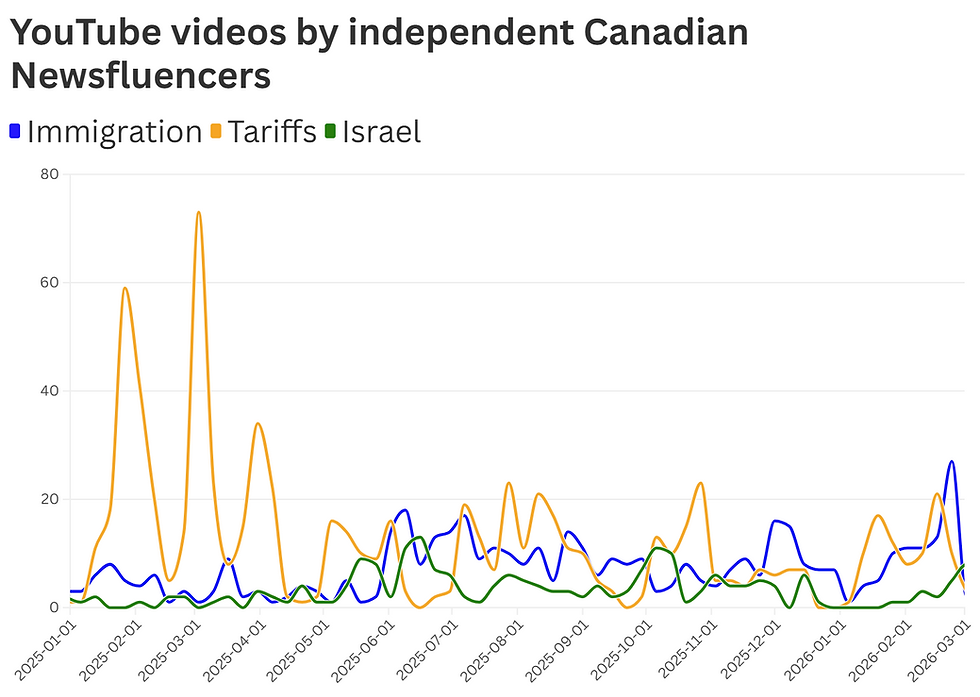
This sustained attention suggests immigration is functioning not merely as a policy issue but as a structural narrative within the digital political discourse, providing a recurring frame through which other domestic concerns are interpreted.
In many cases, immigration is linked to broader narratives concerning cost of living, housing availability, and pressures on public services.
Narrative Ownership: A Politically Skewed Conversation
A defining characteristic of the immigration conversation on independent YouTube channels is asymmetrical narrative participation.
The majority of immigration-related content originates from right-leaning creators and commentators, while comparatively few left-leaning independent voices are actively engaging with the issue within this ecosystem.

This imbalance has two important implications.
First, it shapes the dominant framing through which immigration is discussed. Content frequently emphasizes the relationship between immigration levels and domestic economic pressures, particularly housing affordability and public service capacity.
Second, the absence of sustained counter-narratives allows these frames to circulate with relatively limited challenge within the platform environment.
This does not necessarily reflect broader public opinion but rather indicates which actors are currently most active in producing content around the issue.
YOU NEED TO KNOW: Reputation Management Through Narrative Intelligence. Read Our Reputation Risk Framework.
Narrative Spectrum Within the Right-Leaning Ecosystem
Although immigration discussions are concentrated among right-leaning creators, the perspectives expressed within that ecosystem are not uniform.
At one end of the spectrum are policy-oriented discussions focused on immigration system management. These narratives frame immigration as necessary for economic and demographic reasons but argue that intake levels must align with Canada’s capacity to absorb population growth.
Within this framing, the central issue is not immigration itself but rather the pace and structure of immigration policy.
At the other end of the spectrum are more ideological narratives that frame immigration as a systemic threat to national identity or social cohesion. These narratives tend to circulate within smaller but highly engaged online communities.
The coexistence of these perspectives illustrates the fragmented nature of the digital commentary environment, where policy analysis, political messaging, and ideological content often occupy the same narrative space.
Institutional Messaging and Political Amplification
The federal Conservative Party has increasingly emphasized immigration as a core component of its political messaging. Following earlier success with cost-of-living narratives, CPC communications have expanded to focus on immigration policy reforms, including proposals related to access to health services by asylum seekers.
These parliamentary interventions frequently serve as catalysts for online discussion. Independent creators often amplify speeches, policy proposals, and parliamentary motions, integrating them into broader commentary about economic and social pressures in Canada.
As a result, political messaging originating within Parliament often propagates through the independent media ecosystem, where it is reframed and redistributed to online audiences.
The Absence of Counter-Narratives
One of the most notable findings from the current analysis is the relative absence of sustained pro-immigration narratives within the independent YouTube ecosystem.
Advocacy for immigration’s economic and demographic benefits remains largely concentrated in traditional media, academic commentary, and institutional reports. These perspectives are far less visible within decentralized creator networks that increasingly shape online political discourse.
This absence creates a narrative asymmetry.
Audiences consuming immigration content within independent media ecosystems are frequently exposed to critiques of immigration policy but encounter fewer explanations of the strategic rationale behind Canada’s immigration framework.
Without consistent counter-messaging, narrative environments can become self-reinforcing, where certain frames gain momentum simply because they are repeated more frequently within the platform ecosystem.

Comments