

Reputation Risk: Definition, Drivers, Measurement, and Management
Reputation risk refers to the potential loss of stakeholder trust when perceptions of an organization diverge from its actions, performance, or stated values.
Understanding Reputation Risk
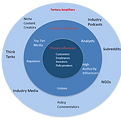
Reputation risk emerges when a gap develops between how an organization intends to be perceived and how it is actually perceived by its stakeholders. That gap erodes trust and can materially affect enterprise value. The 996 Reputation Risk Framework examines how these gaps form and evolve by analyzing narrative momentum, authority amplification, and perception polarization by different stakeholder groups.
Reputation risk may originate from a single event, but more often it is cumulative and dynamic—shaped by how stakeholders interpret all of the actions, decisions, and narratives surrounding an organization makes over time. In an environment defined by polarization, digital amplification, and geopolitical uncertainty, reputation risk has become one of the most consequential, and least understood, enterprise risks facing organizations today.
Many organizations wait until their reputation is in crisis before they take action. This reactive posture is one of the biggest challenges boards and executive teams face. Managing reputation risk requires a reset in how it is governed, measured, and reported: shifting away from opinion-based reactions toward evidence-based insights that both protect and strengthen an organization’s reputation.
Why Reputation Risk Matters
Reputation directly affects an organization’s ability to operate, compete, and grow. Loss of trust can:
-
Increase regulatory and political scrutiny
-
Erode customer loyalty and employee engagement
-
Reduce investor confidence and strategic flexibility
-
Amplify the impact of operational or compliance failures
Reputation risk is often most visible during crises—but it is shaped long before a crisis emerges. Organizations that treat reputation risk as episodic or reactive are frequently surprised by how quickly narratives harden and options narrow.

The Main Drivers of Reputation Risk
Reputation risk typically emerges from a combination of internal and external forces. Enterprise Risk Management has traditionally focused on identifying and managing internal drivers of reputation risk, often underestimating the impact of external forces. In today’s increasingly complex and interconnected environment, board and executive leaders are recognizing that external drivers can materially shape business outcomes.
Internal drivers include leadership decisions, corporate culture, employee behavior, governance gaps, and misalignment between stated values and actual practices.
External drivers include regulatory action, geopolitical developments, media scrutiny, activist pressure, and third-party behavior across supply chains, partners, and investment portfolios.
What makes reputation risk uniquely challenging is that it is often decentralized, with multiple risk owners and no unifying way to define, assess, or measure the organization’s risk appetite. In the absence of an evidence-based reputation risk framework, internal misalignments can escalate rapidly when amplified by external actors across digital platforms and polarized audiences

How Reputation Risk Evolves
Reputation risk does not appear overnight. It develops through identifiable patterns:
-
Early signals emerge in stakeholder conversations and sentiment
-
Influential voices amplify or legitimize narratives
-
Perceptions harden, increasing polarization and reducing trust
-
Strategic and operational consequences follow
The ability to detect and interpret early signals is often the difference between managing risk proactively and responding under pressure.


How Reputation Risk Can Be Measured
Although reputation is intangible, reputation risk is measurable. Effective measurement focuses on evidence rather than opinion and emphasizes change over time rather than static scores.
At 996 Advisors, we approach measurement through a predictive lens—identifying emerging risks before they crystallize into crises. Measurement is not about proving reputation is “good” or “bad”; it is about understanding direction, momentum, and potential impact.

The 996 Reputation Risk Framework
We assess reputation risk across three interconnected dimensions:
Momentum
Momentum captures how the volume and intensity of conversation are changing over time. Rapid growth or sudden shifts in attention often signal emerging risk—or opportunity—before outcomes are visible.
Authority
Authority reflects who is shaping the narrative. Not all voices carry equal weight. This dimension assesses whether influential stakeholders—such as regulators, media, political actors, or industry leaders—are legitimizing or amplifying specific narratives.
Perception and Polarization
This dimension tracks how perceptions are shifting and whether opinions are converging or becoming more polarized between different types of stakeholders. Rising polarization often indicates that issues will be harder to resolve and more costly to manage.
Together, these dimensions provide early warning signals and help organizations prioritize where intervention is most needed.

Governance & Accountability
Effective reputation risk management requires clear ownership and is ultimately a leadership and governance responsibility.
Boards and executive teams increasingly recognize reputation risk as an enterprise risk that intersects with strategy, compliance, ESG, brand, and operations. Without defined accountability, reputation risk often falls through the cracks precisely when oversight matters most.
Understanding reputation risk is only valuable if insights inform decisions. Leading organizations use reputation risk analysis to:
-
Create internal alignment on how reputation risk is defined, measured, reported, and owned
-
Identify emerging narratives early through monitoring and analysis, enabling informed engagement with key stakeholders
-
Stress-test strategies against reputational exposure
-
Respond to crises with evidence, not instinct
This shift from reactive management to predictive insight marks the difference between protecting reputation and using it as a strategic asset.

Common Blind Spots in Reputation Risk Management
Many organizations underestimate reputation risk because:
-
They rely on lagging or vanity metrics
-
Responsibility is fragmented across functions
-
Internal culture risks are overlooked
-
Measurement puts too much emphasis on sentiment instead of perception
-
They rely on opinion surveys which measure perception once it is solidified instead of watching for how perceptions are being formed.
These blind spots can create a false sense of security—until perceptions shift faster than decision-making structures allow.

The Reputation Risk Framework in Practice
The principles outlined here form the foundation of how 996 Advisors analyzes and manages reputation risk across markets, stakeholders, and geopolitical contexts.
Rather than treating reputation as a reactive communications concern, this framework is applied through systematic analysis of observable signals — including narrative momentum, influential voices, and shifts in stakeholder perception — to inform decision-making before risks escalate. The same evidentiary approach underpins our predictive analysis, reputation risk audits, ongoing monitoring, and crisis response work.
Grounded in Canadian Narrative Analysis
Our reputation risk analysis is grounded in a uniquely curated database of influential Canadian voices across media, politics, and public affairs.
Through Spin Nation: Decoding Canadian Perspectives and our ongoing ranking of Canada’s most influential news and politics podcasts, we continuously track which voices shape attention, how narratives evolve, and where influence concentrates over time. This creates a living view of Canada’s information environment, not a static snapshot.
We apply proprietary AI analysis, augmented by expert human judgment, to interpret these signals in context. This approach moves beyond surface metrics to assess how narratives actually form, spread, and resonate with Canadian audiences.
The same evidence-based methodology underpins how we assess reputation risk for organizations — ensuring insights that reflect how influence truly operates in Canada, with greater precision and relevance.
.